Search results for
creamy polenta
Filter Results
Sort By:
Recipes
(159)

Easy
Recipes
Cooking the polenta covered allows condensation to build up, eliminating the need for constant stirring.

Recipes
For years polenta reminded me of the Cream of Wheat my mother used to send me off to school with in the morning. It was totally boring. But once I started making polenta for myself I discovered I LOVED it. My special twist? I fat it up with milk, Parm, Fontina cheese, and mascarpone until it’s creamy, decadent, and delicious. Just remember, the kicker here is to season the liquid with plenty of salt in the beginning—it makes all the difference.

Recipes
Polenta alfredo, polenta mac ‘n’ cheese, whatever it is, this polenta is very creamy and cheesy. We like that.
4.0
(3.88)
Easy
Recipes
Given all the fuss that has been made about the difficulty of producing the real thing, I wouldn’t blame you if you bought “instant” polenta. But polenta—and its identical Romanian cousin, mamaliga—is basically cornmeal mush, ethereal when made correctly and hardly neurosurgery. First off, forget about stirring clockwise for 40 minutes with a long-handled wooden spoon or any of the other myths you’ve heard about how it has to be made. If you want great creamy polenta, cook the cornmeal very slowly and add as much butter as you can in good conscience. Second, this is a case where Parmigiano-Reggiano, the real Parmesan, will shine. Finally, note that the amount of water you use is variable: use 5 cups if you want to make very firm polenta that you can later grill or sauté; use more water if you want smooth, soft polenta, into which you will stir cheese and serve as a simple side dish or perhaps with a little tomato sauce. The following recipe is based on one food writer Mitchell Davis learned from the chef at Cibreo in Florence, Italy. You could, of course, omit one or all of the herbs if you didn’t have them on hand. With herbs or without, this polenta is great with any Italian roast or braised dish or with simply grilled Italian sausage.

Easy
Recipes
Call it cheating—we call it 30 minutes you don’t need to spend standing at the stove.
4.6
(4.64)
Quick
Recipes
Water or stock can be substituted for any or all of the milk, but milk makes a creamier polenta.
Recipes
Corn, polenta, came to Italy from the New World, and yet, along with pasta and rice, it is one of the beloved starch dishes of Italy. Polenta was for the northeastern regions of Italy what potatoes were for Ireland. Corn grew in abundance there and fed many people and still does, so much so that the people of the Friuli-Venezia Giulia region are known as polentoni, polenta eaters. I come from the region, and I grew up eating polenta and still do eat it often. As a child I had just cooked or leftover polenta for breakfast with milk and sugar or with caffe latte, or pan-fried with some sugar and cinnamon sprinkled on top, as well as in endless ways accompanying vegetables, meats, fish, and cheeses. It is rather simple to cook—all you need is cornmeal, water, salt, olive oil, and a few bay leaves. When done, you can enjoy the polenta piping hot or let it cool and take shape, then cut and fry it, or grill and bake it, topped with anything you choose. In this chapter you’ll find it with leeks, with bacon lardoons, with Montasio cheese, or with just an egg yolk nestled in a piping-hot mound of polenta. Beyond the flavor of polenta, I look for the mouth feel, and that depends on the grind. Instant polenta will give you a smooth puddinglike texture, the medium grind a bit more texture, and the coarse will have almost a raspy feel in your mouth. There is also white polenta, milled from white corn, which is used much in the Veneto. And the polenta taragna, which has buckwheat milled along with the yellow corn, has much texture and flavor. The one important caution in cooking polenta is to get it smooth. Start it in cold water and whisk well while it cooks; it may take a bit longer but ensures lump-free polenta. Even though polenta might look done, make sure you cook it the recommended time; its digestibility and flavor increase with longer cooking time.
Recipes
When you pour out the polenta to chill, don’t worry about making it pretty. Do what we do at the restaurants and use a cookie or biscuit cutter to create even shapes, or cut out wedges or squares—use your imagination. Grilled or sautéed polenta makes an excellent accompaniment to meat, game, or poultry. Try a couple of disks nestled next to a pork chop, roasted chicken, or guinea hen. Firm polenta should be crispy outside, soft and creamy inside, like a good French fry. In short, everything you could want.
Easy
Recipes
Adding the cornmeal to the water, and avoiding lumps, is the only challenging part of making good polenta. In the restaurants, we make it to order, and I vacillate between using fine and medium grinds, depending on the finished consistency I am looking for. The coarser polenta has more presence on the plate and such a deep corn flavor that I think it’s a good place to start. Of course, fine or “instant” polenta has the advantage of being quicker to make. Traditionally, polenta is made using a wooden spoon, though I use a whisk. If you don’t need or want this much polenta, you can halve the recipe with good results.
Recipes
Polenta, a staple of northern Italian cooking, is coarsely ground cornmeal that is cooked very slowly simmering on top of the stove (or in the oven). Because of the frequent stirring and the incremental additions of liquid, the cooking method is very similar to that used for risotto. Polenta can be served right away, as in the recipe that follows, or allowed to set and then cut into shapes and fried, grilled, or baked. Water is the most common liquid, but for a richer, more flavorful polenta, replace all or some of the water with chicken stock (page 41) or vegetable stock (page 56), reducing salt accordingly, if necessary. Or substitute half the water with milk (preferably whole) for a creamier consistency. This recipe calls for two pots of water for cooking the polenta: one for the initial stage when the cornmeal is whisked into hot water, and the other for additional water that is added gradually while the polenta cooks to reach the desired thickness. Having less water in the first stage helps the cornmeal reach a creamier consistency earlier in the cooking process, so lumps are less likely to form. Once you become familiar with the method and know the thickness you prefer, you won’t need to measure the amount in the second pot. The longer the polenta cooks, the creamier and tastier it becomes (up to a point). The recommended cooking time here is merely the minimum required for the polenta to cook through. If you choose to cook it longer, simply add small amounts of hot liquid as necessary to achieve the desired consistency, making sure that you let the polenta absorb all of the liquid before adding more. The method described below can be used to cook other types of meal, including semolina (coarsely ground durum wheat often used to make puddings) and grits (coarsely ground corn, also known as hominy grits).

Recipes
In his "A Tuscan Son" menu, Tony Oltranti serves Polenta with Franklin's Teleme as a smooth, soft base for his roast chicken. This recipe takes polenta in a different direction—cooked with sage, rosemary, and Parmigiano-Reggiano, the polenta is then cooled, cut into sticks, and broiled until the outer edges of the "fries" are golden and crisp, a fine contrast to the creamy interior. Serve them with a fried egg and a salad for a vegetarian lunch, or pair them with something saucy like chicken fricassee.
Quick
Recipes
Polenta is the frequent flier of the cornmeal set. Just about anywhere there’s an airport, you’re likely to find some version of this staple. Hungarians call it puliszka, the Turks call it mamalika, and us Americans—well, we just call it grits. Polenta is fabulous to work with because it morphs itself amiably into so many settings. I’ve seen it prepared with tomato sauce, different cheeses, various oils, garlicky greens, you name it. This version is somewhat similar to oatmeal (think thin oatmeal, not the stuff that doubles as wallpaper paste) using Magic Mineral Broth to add taste and nutritional value far beyond what you’d get with plain water.
Articles
(34)

Cooking
This riff on Cantonese salt-and-pepper shrimp transforms it into a crispy, fried delight.
Chris Morocco

techniques
Trust: You want your polenta to be creamy, not sandy. Here's how it's done.
Rick Martinez
Cooking
With this new technique, you can have creamy, perfectly cooked polenta without ruining your cooking arm.
Alyse Whitney
Cooking

Cooking
Don't pretend like you haven't asked this before.
Alex Delany

Cooking
Laura Wright from The First Mess on how she nailed this alt-grain dish.
Laura Wright
Videos
(291)

icon
You don't just taste it, you feel it. Check out PHILADELPHIA Cream Cheese Frosting recipe.

icon
Join chef Samantha Seneviratne as she makes Ruffled Milk Raspberry Pie. Galatopita, or ruffled milk pie, is a Greek dessert in which phyllo is baked directly into a simple custard. It’s prepared in stages so the top stays buttery and crisp while the bottom turns into a sort of phyllo bread pudding.
icon
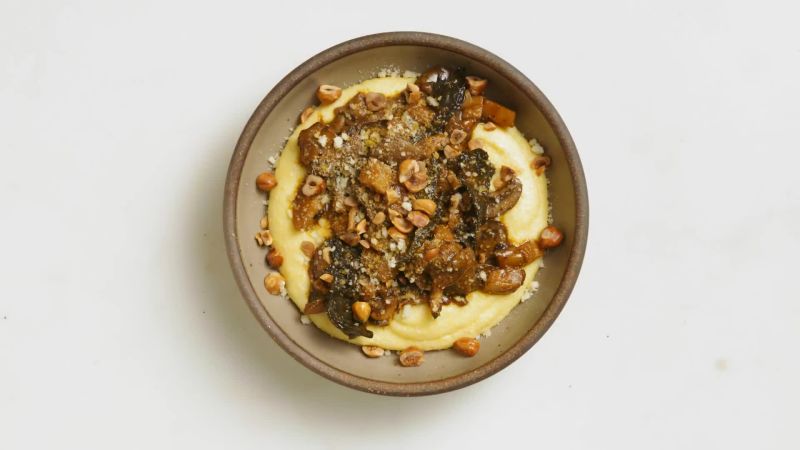
We show you how to make Mushroom Ragout with Polenta.

icon
How to use the bulk bins to make a delicious and healthy polenta dish.

icon
The sauce is bright yellow from fresh eggs, and each bucatini hides cubes of fatty guanciale. This yolk-heavy recipe is beyond creamy—without cream!—with black peppercorns. It's unlike any clumpy carbonaras you've had. The tricks? Omitting most of the egg whites; their water thins the sauce. It's a pasta worth mastering.

icon
Carla shows us how to make Polenta Cacio e Pepe using the hot new trend in cooking appliances–Instant Pot.
Check out the recipe here: http://bit.ly/2EbLB0D
Buy the Instant Pot DUO80 here: http://amzn.to/2scrQjO